
Since August 1, 2023, China’s State Administration for Market Regulation has officially included mobile power banks (portable chargers) in the mandatory product certification (3C certification) directory, stipulating that from August 1, 2024, power banks without 3C certification certificates and marks must not be manufactured, sold, imported, or used in business activities. This means power bank factories must not only pass product type testing but also undergo an annual “factory inspection”—commonly known in the industry as the “3C audit.” During this audit, an increasing number of factories are discovering that without a dedicated power bank factory MES system, auditors’ required documentation cannot be fully collected, cross-referenced, or explained clearly, leaving audit risks alarmingly high. Baofeng Charge, a company deeply engaged in power bank manufacturing and digital services, offers a MES system purpose-built for 3C audit compliance, helping factories implement genuine quality assurance capabilities and confidently pass every factory inspection.
What Does a 3C Factory Audit Actually Inspect?
The 3C factory audit, formally known as the “Mandatory Product Certification Factory Quality Assurance Capability Inspection,” is conducted according to the “Implementation Rules for Mandatory Product Certification—Factory Quality Assurance Capability Requirements” (CNCA-00C-002). Audit formats include initial inspection (before certification), annual supervision inspection (once per year), and unannounced/flying inspections (surprise audits without prior notice). According to Mordor Intelligence’s power bank market report, as the global power bank market expands, regulatory scrutiny of battery products is tightening worldwide. Regardless of format, the audit centers on the following areas:
- Quality assurance capability system: Whether the factory has established and operates a documented quality management system, retains required records, and assigns quality responsibilities clearly;
- Production process control: Whether people, machines, materials, methods, environment, and measurement (5M1E) are controlled from incoming to packaging, and whether process documents match actual operations;
- Certified product consistency: Whether mass-produced power banks match type-test samples—battery cells, PCBA, protection boards, casings, and other critical components must match certified supplier, model, and specification information;
- Inspection and nonconforming product control: Whether incoming (IQC), in-process (IPQC), and outgoing (OQC) inspections follow sampling plans, and whether nonconforming products are isolated, handled, and fully traceable.
In short: the audit checks “are you following the rules” and “can you prove you followed the rules.” The former relies on system procedures; the latter on documented evidence. If a serious nonconformity is found, the consequences range from rectification orders to suspension or revocation of the certification certificate—halting production, disrupting deliveries, and damaging brand reputation far beyond expectations.
Why Manual Management Causes Audit Failures
Many power bank factories do have quality management awareness, but their tools remain at the paper work-order and Excel spreadsheet stage, leading to four major pain points:
- Broken traceability chain: When a quality complaint arises (e.g., battery cell swelling, false capacity labeling) and batch tracing is needed, paper work-orders take hours to sift through—material batches, process parameters, and operator records don’t align;
- Dubious record authenticity: During on-site verification, retroactively created records, inconsistent handwriting, and timeline contradictions are easily exposed—one flawed record can trigger a nonconformity finding;
- No basis for consistency checks: Silent changes to critical components without proper change-control processes create mismatches with certified information—one of the most fatal nonconformities in audits;
- No evidence for surprise inspections: Flying inspections often provide only hours of notice; under manual management, there’s no time to assemble an “audit response package,” leaving factories passively exposed.
Beyond these, the cost of manually preparing audit materials is staggering: before each audit, quality departments typically pull multiple staff members for days of document backfilling, ledger reconciliation, and report generation. Statista’s manufacturing data confirms that hidden quality-related costs far exceed visible scrap rates. The root cause: quality data is never automatically captured, systematically stored, traceable, or auditable.
How a Power Bank Factory MES System Solves Audit Challenges
MES (Manufacturing Execution System) is a digital system that manages production-floor data. For power bank factories, it addresses audit core requirements across four dimensions:
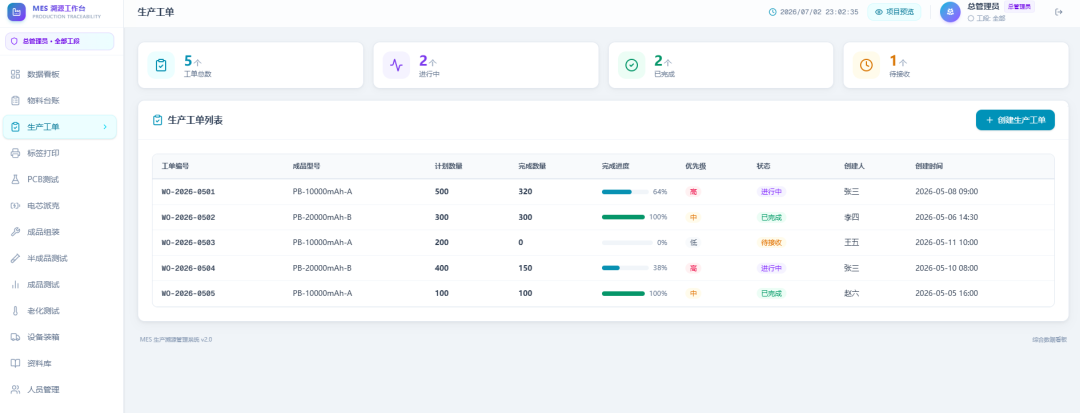
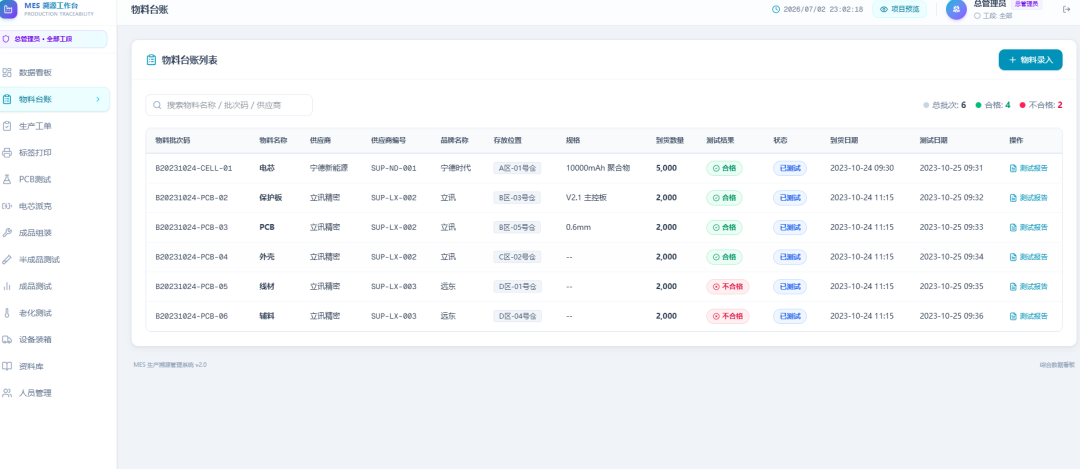
- Full-process batch traceability for consistency checks. MES assigns a unique traceability code to each work order and product; battery cells, PCBA, protection boards, and other critical materials are scanned and bound to batches, while each station automatically records operator, equipment, timestamp, and process parameters. Auditors request anything—the system delivers instantly, enabling “forward-traceable, reverse-trackable” verification. For a deeper dive into how traceability resolves quality crises, see our published analysis of Baofeng Charge manufacturing technology.
- Electronic inspection data for compliant records. IQC, IPQC, and OQC results are entered in real time, complete with inspection standards, sampling plans, pass/fail judgments, and inspector e-signatures—eliminating retroactive records. Aging tests and charge-discharge parameters are captured automatically, every record timestamped and audit-ready.
- Error-proofing (poka-yoke) for genuine process control. Built-in routing and parameter validation auto-blocks wrong-material usage, skipped stations, and out-of-tolerance parameters. Nonconforming products are scanned into quarantine zones, with rework and scrap fully logged—forming a closed-loop management system.
- Tamper-proof data and audit trails for flying inspections. MES provides permission management and operation logs for all critical data—who changed what, when, is always recorded. Data accumulates continuously through daily operations, so during a flying inspection you simply open the system and retrieve records on the spot—transforming “fear of inspection” into “inspect anytime.”
In essence, a power bank factory MES system transforms the 3C audit’s four key requirements—”consistency, traceability, complete records, controlled processes”—into daily operations rather than last-minute cramming before an audit. Grand View Research market forecasts confirm that compliance and quality control demands are the primary drivers of manufacturing digital transformation.
Baofeng Charge MES: Built for Audits, Tailored for Power Bank Manufacturing
Many MES systems exist, but the power bank industry has unique characteristics: complex bills of materials, sensitive process parameters, and specialized 3C audit rules that generic MES systems often cannot accommodate. LinkedIn industry insights confirm that vertical-specific MES solutions outperform generic alternatives in deployment outcomes. Baofeng Charge’s MES system is purpose-built for power bank factories:
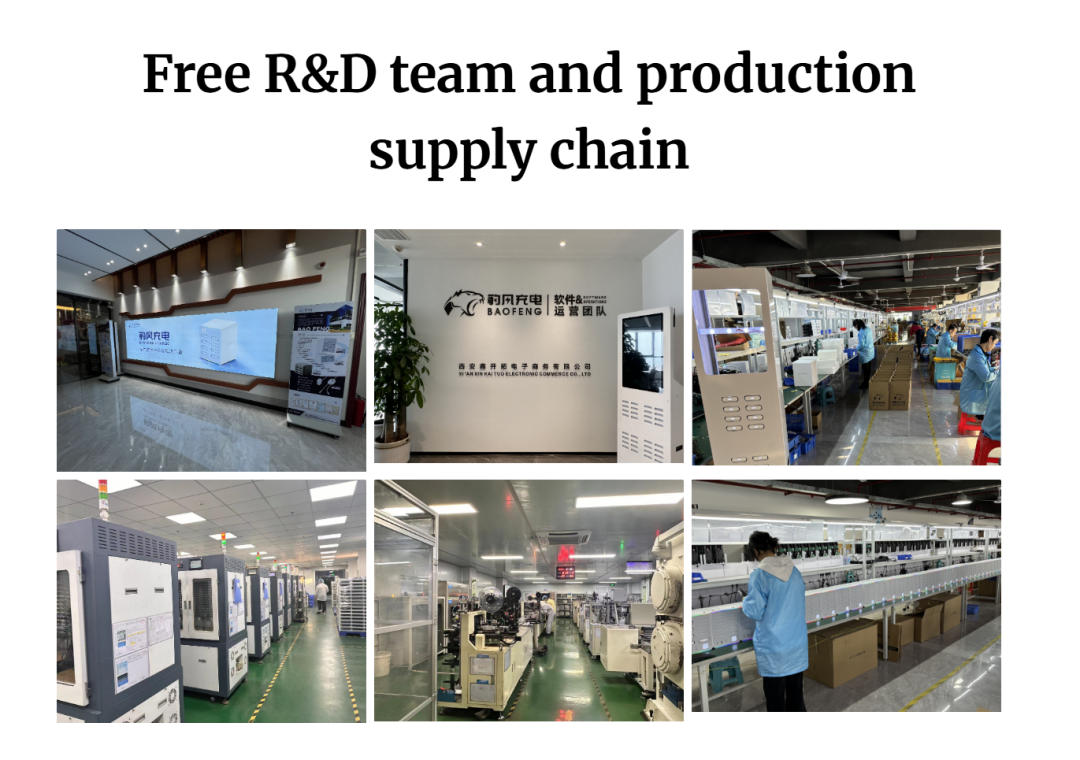
- Industry know-how: The R&D team comes directly from power bank manufacturing frontlines, familiar with cells, PCBA, injection molding, assembly, aging, and packaging processes. The system comes pre-loaded with industry inspection standards and 3C audit checklist points—ready to use out of the box;
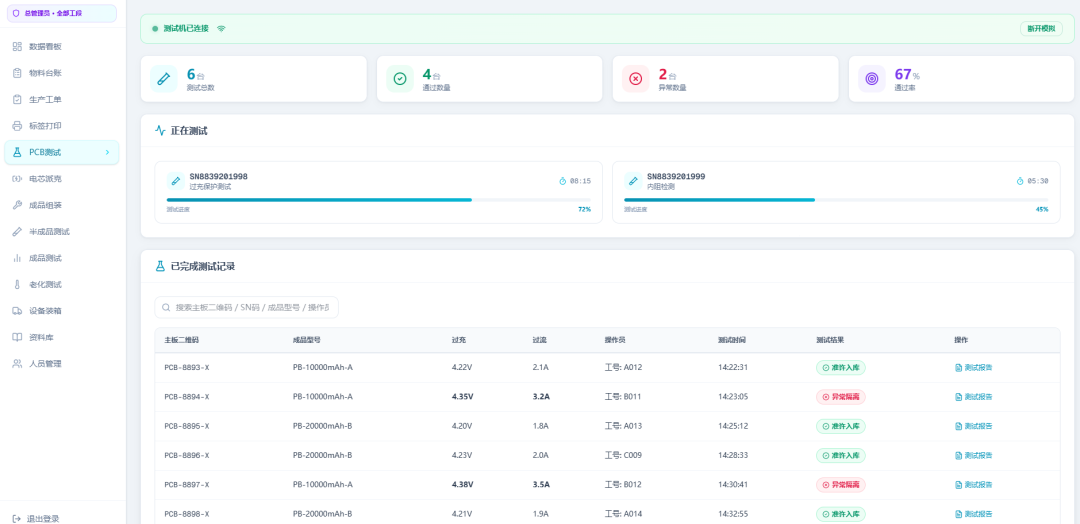
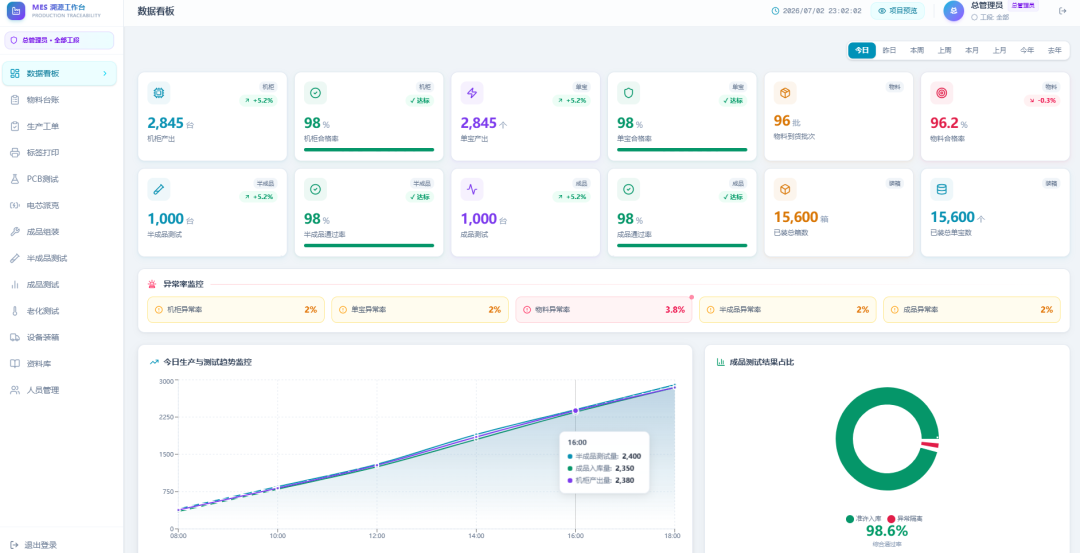
- Comprehensive module coverage: Work order management, material batch traceability, IQC/IPQC/OQC inspection, nonconforming product management, equipment and fixture management, error-proofing, electronic kanban, and one-click audit report export—covering all audit inspection items;
- Lightweight rapid deployment: Designed for SMEs—no large-scale line modifications needed; barcode scanners and workstation terminals get you started, with implementation completed in weeks;
- Audit escort service: Beyond software, we provide 3C audit coaching—helping companies self-assess against checklists, fill record gaps, and rehearse audit-response procedures until they pass factory inspection. One factory client passed its annual supervision audit on the first attempt within 3 months of going live, with the auditor’s on-site traceability record queries all hitting targets.
Conclusion
3C certification is the “birth certificate” for power bank production; the factory audit is an annual “big exam” every manufacturer must pass. Rather than cramming records overnight before each audit and gambling on luck, it’s far better to build quality assurance capabilities on a systematic foundation. Baofeng Charge‘s MES system enables your factory to achieve “traceable data, auditable records, controllable processes, and composed audits.” Spherical Insights analysis notes that manufacturers that complete digital quality management early will gain a significant competitive moat in the tightening compliance cycle.
Take action now: Contact Baofeng Charge to get your power bank 3C audit MES solution and a free on-site diagnostic—turn audit compliance from a burden into a competitive advantage.