
Since 2024, China’s State Administration for Market Regulation (SAMR) has steadily tightened its CCC (Compulsory Certification) factory audit requirements for mobile power banks — see the official Certification and Accreditation Administration of China for the latest compulsory certification catalogue. From cell grading and Pack assembly to aging tests and outgoing inspection, nearly every critical process step now falls within the scope of a factory audit. For power bank brands and OEM/ODM manufacturers, the era of “get the certificate and relax” is over. A factory audit is no longer a one-time exam — it is a continuous, traceable, and verifiable assessment.
One factory owner put it bluntly: “We spent 2 million RMB building a certified lab, yet the auditor spent only 30 minutes reviewing our ERP and MES records. Once the data chain breaks, the certificate is just paper.” This is not an exaggeration. Among the hundreds of factory clients served by Baofeng Charge, we have seen countless cases where missing process data led to non-conformity findings on the spot. An MES system has evolved from a “nice-to-have IT project” into a mandatory requirement for passing a power bank CCC factory audit.
1. What Does a CCC Factory Audit Actually Examine?
Many factory managers assume a factory audit is mainly about hardware, equipment, and test reports. In reality, it goes far deeper. Under GB 31241 (“General Specification for Lithium-ion Cells and Batteries Used in Portable Electronic Devices”) and the applicable CCC implementation rules, auditors focus on two core themes: process controllability and data traceability. The review typically covers six dimensions:
1.1 Identification and Control of Critical Processes
Are cell matching, spot welding, sealing, protection-board parameter writing, and aging tests supported by clear process documents, work instructions, and real-time records?
1.2 Calibration and Maintenance of Key Equipment
Are calibration certificates, daily check records, and maintenance logs complete for capacity-grading cabinets, spot welders, internal-resistance testers, and temperature-controlled aging rooms?
1.3 Material Traceability and Consistency
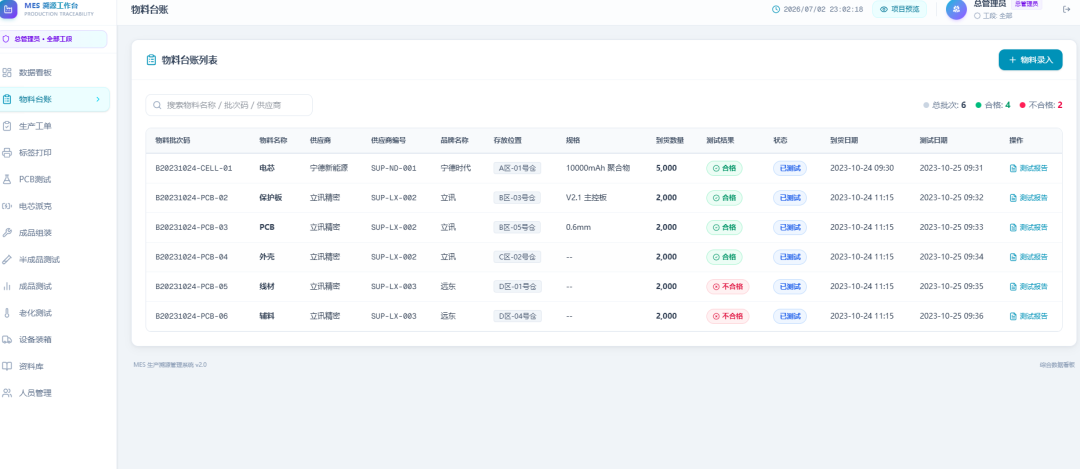
Can the factory clearly link cell batches, protection-board batches, and PCBA batches to finished-product serial numbers — and trace a single cell all the way from incoming inspection to shipment?
1.4 In-Process Quality Data
Are process parameters such as welding current, internal resistance, capacity, and protection settings collected, judged, and alarmed automatically?
1.5 Nonconforming Product Handling
Is there a closed-loop record of how defective units are identified, quarantined, re-inspected, and scrapped?
1.6 Operator Qualification and Training
Are training records, work permits, and assessment results available for critical positions such as welding, testing, and OQC?
In short, auditors are not asking “how big is your factory” or “how new are your machines” — they are asking whether your processes are under control and whether your data can withstand scrutiny. Traditional approaches built on manual Excel sheets, paper forms, and after-the-fact ERP entry stand little chance against this level of granularity.
2. Why an MES System Is a Must-Have for Factory Audits
A Manufacturing Execution System (MES) is the middleware that connects ERP with the shop floor. It receives production plans from ERP on one side and reaches down to every machine, workstation, and operator on the other, turning the workshop into a digitally transparent environment. For a power bank CCC factory audit, an MES system delivers three irreplaceable capabilities.
2.1 Automated Data Collection — No More Backfilling Records
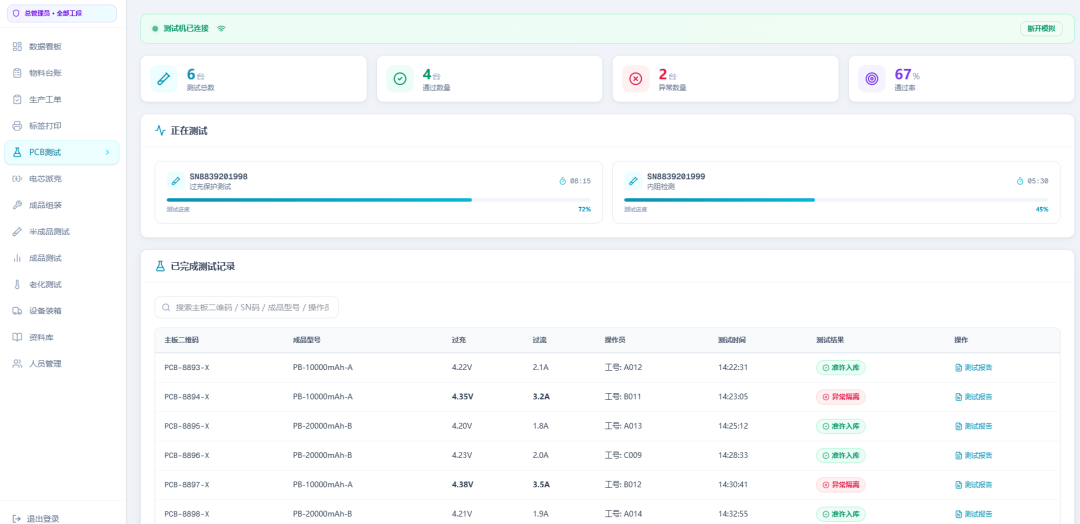
In traditional mode, operators hand-write welding parameters and copy aging data on paper. When an auditor asks, “What was the welding current of the 50th unit this machine produced yesterday?” the supervisor digs through paperwork — and often cannot find the answer. An MES system interfaces with PLCs, barcode scanners, and sensors to capture critical parameters in real time and write them automatically into a database. Every record carries four elements: timestamp, equipment ID, operator ID, and work order number. Auditors can retrieve authentic data for any moment and any process, eliminating the risk of “compliance on paper, chaos in practice.”
2.2 Error-Proofing and Process Interlocks
An MES system can embed built-in poka-yoke logic. During cell matching, the system automatically verifies the consistency window of capacity, internal resistance, and voltage — out-of-range cells lock the workstation and cannot move to the next step. During spot welding, the system monitors current, pressure, and hold time in real time; any parameter drifting outside the process window triggers an immediate alarm and machine stop. This level of in-process error-proofing is the hardest evidence of “process controllability” that auditors want to see — something manual patrols and after-the-fact sampling can never achieve.
2.3 End-to-End Traceability with One-Click Reverse Lookup
The MES system gives every power bank a unique “birth file”: incoming cell barcodes, protection-board batches, PCBA serial numbers, welding parameters, aging curves, OQC inspection results, carton numbers, and customer order numbers form a complete “product genealogy.” When an auditor samples any finished unit on the spot, the MES system can reverse-lookup the entire process history within three seconds — which cell batch, which welding machine, which operator, which date, which aging curve. This “one-click penetration” is the killer feature for CCC factory audits.
3. The Baofeng MES System: A Factory-Audit Solution Built for the Power Bank Industry
Generic MES platforms are everywhere, but few truly understand power bank manufacturing processes, CCC audit rules, and the pain points of OEM/ODM factories. Built on 10 years of hands-on power bank R&D and manufacturing experience, the Baofeng Charge MES system is one of the rare solutions that combines power bank process DNA, CCC compliance DNA, and shop-floor practicality in a single platform.
3.1 Industry Process Templates — Ready Out of the Box
The Baofeng MES system ships with process templates covering the entire power bank production flow: cell grading, cell matching, spot welding, PCBA testing, sealing, glue potting, full-unit aging, capacity testing, and OQC shipment. Process parameters, acceptance criteria, and record fields are pre-configured. Clients simply import a product model and go live — deployment can be completed in as fast as two weeks.
3.2 Deep Alignment with CCC Audit Scenarios
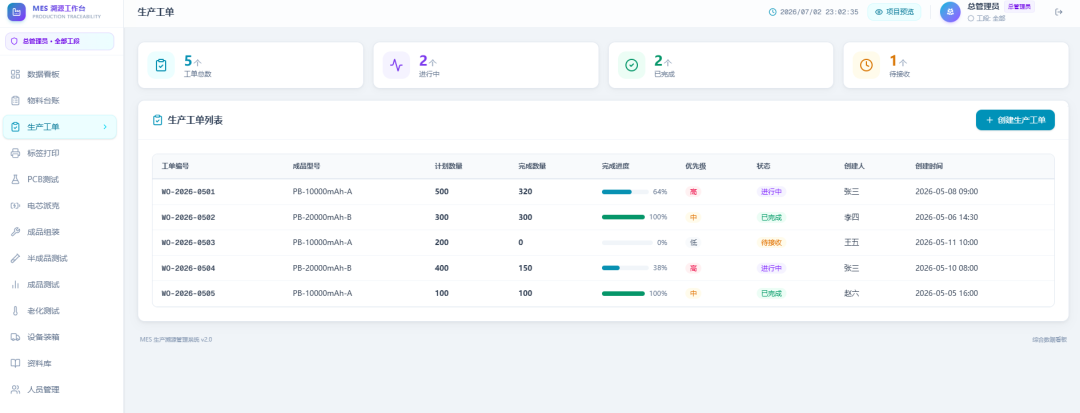
The Baofeng MES team has participated in more than a hundred power bank factory audits and knows the auditor checklists and common non-conformities by heart. All six audit dimensions — critical process control, equipment calibration management, material batch traceability, process data collection, nonconforming product handling, and personnel qualification management — are built in from day one, and the system automatically generates process reports in the formats auditors expect. Clients effectively gain a “pre-audit capability”: before the auditor arrives, the system exports a complete compliance data package, eliminating the embarrassment of flipping through paper records on site.
3.3 Software-Hardware Integration with Broad Equipment Compatibility
The Baofeng MES system supports mainstream brands of capacity-grading cabinets, spot welders, internal-resistance testers, and aging rooms, connecting via PLC, serial port, Ethernet, or barcode scanner. Even for legacy equipment, Baofeng can implement automatic data collection through customized retrofit — no need to scrap existing machines and start over.
3.4 Remote Visualization — Supervise the Factory from Anywhere
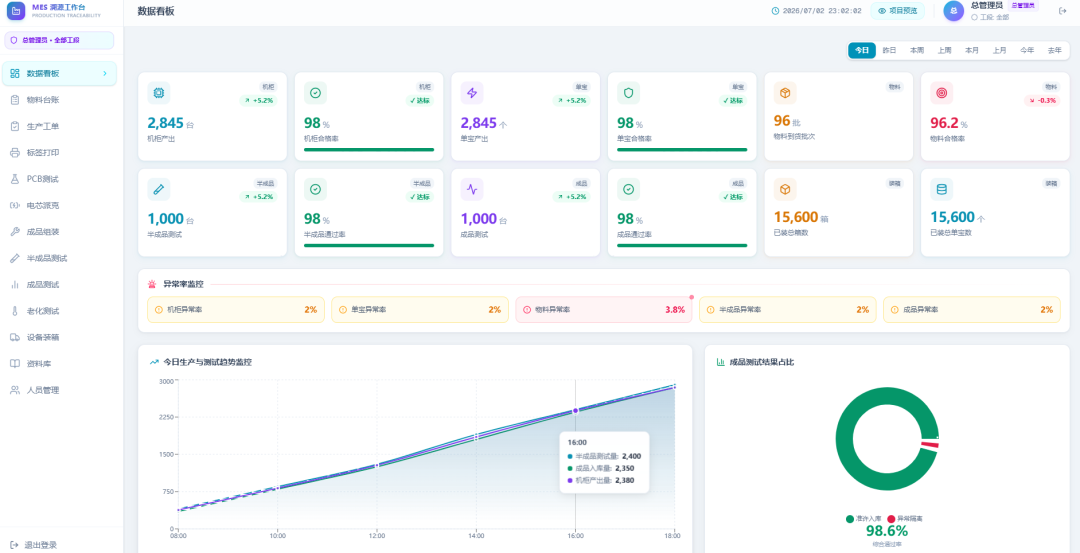
The system supports mobile, PC, and big-screen dashboards. Owners traveling abroad can check real-time output, defect rates, equipment status, and labor efficiency of every line from their phone. During an audit, management can pull up any process data from the office and show the auditor a genuinely digitalized factory.
4. Real Results Delivered by the Baofeng MES System
A mid-sized power bank ODM factory in Shenzhen used to spend two months before every CCC audit manually backfilling records, consuming three to five full-time staff. After deploying the Baofeng MES system, audit preparation time shrank from two months to two days, process data became 100% automatically collected and instantly retrievable, and the factory passed three consecutive CCC factory audits with zero non-conformities.
Key results: audit preparation time down 97% | process defect rate down from 3.2% to 1.1% | over 1.5 million RMB saved in rework costs annually
A battery PACK factory in Dongguan saw its process defect rate drop from 3.2% to 1.1% after adopting the Baofeng MES system, saving more than 1.5 million RMB per year in rework costs. With complete process traceability in hand, the factory also entered the supply chains of several leading brands — significantly improving its pricing power on orders.
These cases prove a simple point: an MES system is not a cost center — it is revenue-generating compliance infrastructure. A one-time MES investment pays back through worry-free audits, better quality, order premiums, and brand upgrades.
Conclusion: Choosing an MES Means Choosing Five Years of Audit Confidence
CCC certification in the power bank industry is shifting from an entry barrier to a continuous one. Factory audits are no longer a single exam but an ongoing assessment. Whoever controls complete, accurate, real-time process data will handle audits with confidence — and stand out from the competition.
According to market research from Mordor Intelligence, the global power bank market will keep growing steadily over the next five years, and major brands are applying ever-stricter manufacturing compliance screens on their suppliers. Reports from Coherent Market Insights and DataIntelo point the same direction: with fast-charging power climbing and safety standards tightening, quality transparency in manufacturing is becoming a core criterion for brand owners when selecting ODM partners.
The Baofeng Charge MES system is built for power bank factories, designed for CCC factory audits, and evolved for both compliance and efficiency. Whether you are a brand owner, an OEM/ODM factory, or a newcomer to the industry, choosing Baofeng MES means choosing five years of audit confidence. For more hands-on insights, read our earlier guide on why power bank factories need an MES system for CCC audits.
Baofeng Charge has spent 10 years focused on the R&D and manufacturing of shared power banks, offering integrated services covering MES systems, ERP, IoT hardware, and CCC factory-audit consulting — helping your factory move from experience-driven to data-driven. Contact Baofeng Charge today to book a free MES diagnosis and CCC audit pre-assessment!
Baofeng Charge | www.baofengcharge.com | Making Charging Simpler