
Baofeng Charge (BAOFENG CHARGE), a leading global provider of shared power bank solutions, has officially entered the Mexican market. After expanding across Southeast Asia and the Middle East, Mexico — Latin America’s second-largest economy, with 120 million people and smartphone penetration above 80% — becomes the latest strategic anchor in Baofeng Charge’s global map.
This article breaks down the Mexico deployment plan across four dimensions that decide whether a shared power bank business actually works: hardware, software, payment integration, and localization.
Why Mexico Is the Right Market for Shared Power Banks Right Now
Mexico’s cities run on long, social evenings. Restaurants, cantinas, bars, malls, and shopping districts are dense and busy, and customers stay for hours. That combination — high foot traffic, long dwell time, and an urgent need for on-the-spot charging — is exactly the profile that makes shared power banks profitable.
At the same time, mobile payments are maturing fast in Mexico. Digital wallets and real-time bank transfers have moved from novelty to mainstream, and convenience-store cash networks already cover the populations that banks do not. In other words, the two preconditions for power bank sharing — venues full of people who need a charge, and a way to collect payment from them — are both now in place.
Hardware: Super-Fast Charging Cabinets Built for Mexican Venues
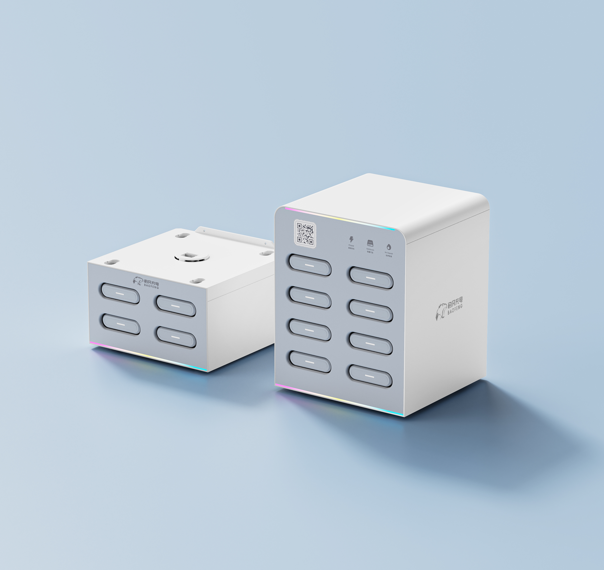
Baofeng Charge’s flagship lineup for Mexico is its PD fast-charging series: modular power bank cabinets and the power banks inside them, engineered for high-traffic commercial spaces.
Charging performance that covers phones and laptops
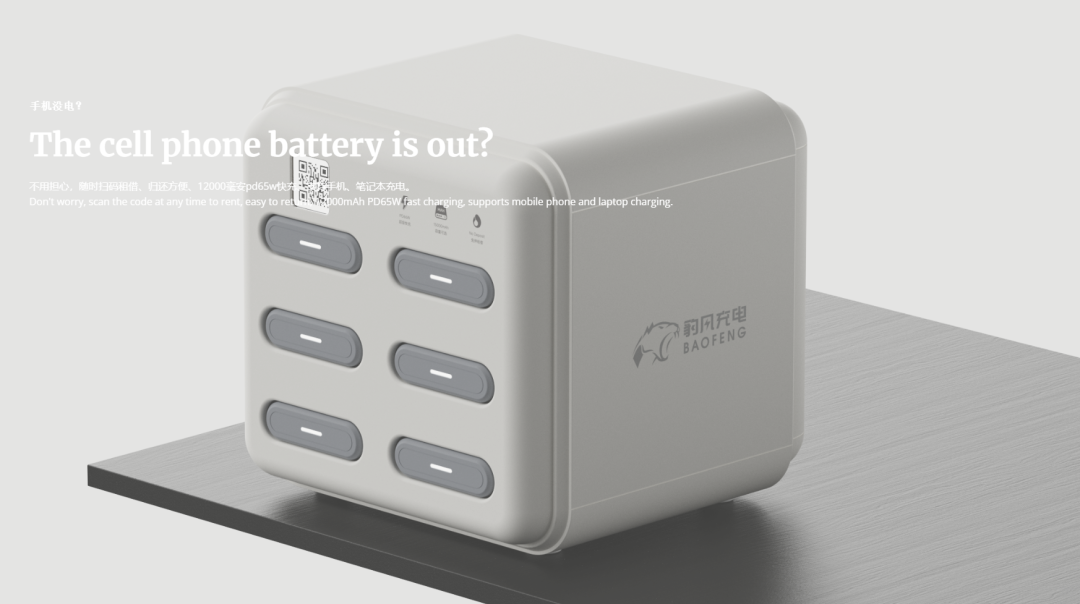
The power banks range from 8,000mAh to 15,000mAh and support 22.5W to 100W super-fast charging, compatible with the mainstream PD and QC protocols. The flagship model packs a 12,000mAh battery with PD 65W two-way fast charging — enough not only to top up a phone quickly, but also to power a laptop. That dual capability matters in business districts and coworking venues, where users expect a rental power bank to do more than one job.
Modular design: cutting cross-border maintenance costs
Structural design is where Baofeng Charge’s manufacturing depth shows. The full product line uses a modular architecture with 80% shared components, so cabinets can be disassembled and repaired locally without being shipped back to the factory. For an operator running equipment across borders, that single decision removes the largest recurring cost in the business — international RMA logistics.
The patent-pending replaceable charging cable solves the industry’s biggest wear-and-tear problem: the cable, not the battery, is almost always the first thing to fail. Multi-color battery indicator lights let users read charge status at a glance. And the stacked cabinet design lets merchants choose the number of slots that fits their venue, from a small café to a large supermarket, instead of buying a fixed-size unit.
Certifications and delivery
Baofeng Charge products already hold 3C, CE, and FCC certifications, and can complete Mexico-specific approvals such as NOM for electrical safety. Combined with Baofeng Charge’s global logistics network, this shortens delivery cycles for partners in Mexico considerably compared with importing unapproved hardware.
Software: A Full-Stack SaaS System for Users, Merchants, and Operators
The core of the shared power bank business is not the hardware — it is the system. Baofeng Charge maintains an independent software R&D team in Xi’an, China, and has built a mature sharing platform with three distinct interfaces.
The user app: scan, rent, return anywhere
Users rent by scanning a QR code and return at any station in the network. Access is available through both a mini-program and a native app, and the entire interface has been adapted for Spanish. For Mexican users, that means no language friction at the exact moment they are deciding whether to trust the service.
The merchant app: hands-off management
Partner venues get a merchant app that shows cabinet performance data, revenue share, and device status in real time. Staff do not need to reconcile anything manually — the system handles settlement and reporting, which is what makes the model viable for cafés and bars that have no appetite for operational overhead.
The operator backend: a business in a dashboard
For local operators, Baofeng Charge provides a SaaS management backend covering the full workflow: device mapping, order settlement, remote maintenance, and marketing campaign configuration. Operators can launch a local business quickly instead of building software from scratch.
Powered by IoT connectivity, the backend monitors each device’s online rate, rental frequency, and fault alerts in real time. An operator sitting in an office can see the health of the entire network without visiting a single venue. To see how this system performs across other markets, read about Baofeng Charge’s deployment across 25 countries and regions.
Payments: Solving Mexico’s Cash-Heavy Last Mile
Mexico is one of the most cash-dependent markets in the world. Whether a shared power bank business works there depends directly on whether it can collect payment the way Mexicans actually pay. Drawing on years of overseas payment development by its Hong Kong team, Baofeng Charge already supports more than 200 payment methods globally and has completed deep localization for Mexico:
- Mercado Pago — Latin America’s largest digital wallet, with one-tap payment when renting;
- Credit and debit cards — supporting Visa, Mastercard, American Express, and other international card networks;
- OXXO cash payments — connected to Mexico’s ubiquitous OXXO convenience store collection network, serving customers without bank accounts or cards;
- SPEI bank transfers — integrated with Mexico’s real-time payment clearing system for larger and enterprise transactions.
Multi-currency settlement and card support mean local operators can price in pesos and settle in local currency, eliminating exchange-rate exposure and clearing friction. This is the difference between a service that only tech-savvy users can access and one that the whole market can use.
Localization: Beyond Translation, Into the Local Ecosystem
Baofeng Charge treats going global as deep integration with a local ecosystem rather than a one-way export of product. In Mexico, that translates into four concrete commitments:
- Language localization: user apps, merchant apps, and customer support are fully localized in Spanish, backed by a local team responding 24/7.
- Certification and compliance: Baofeng Charge assists partners in completing Mexico’s mandatory market-entry requirements, including NOM electrical certification and IFETEL wireless certification.
- Channel and operations support: OEM/ODM customization is available, so cabinet colors and branding can be tailored to a local operator’s identity, with end-to-end support from market launch onward.
- Business model adaptation: flexible revenue-sharing structures and an agent system designed for Mexico’s merchant landscape, lowering the barrier for local entrepreneurs to enter the market.
Market Signals: What the Research Says
The opportunity is not just anecdotal. Industry analysts tracking the battery-sharing and portable charging markets consistently flag emerging economies as the fastest-growing regions. Mordor Intelligence, for instance, projects sustained growth in demand for on-demand charging services as smartphone reliance deepens in markets like Mexico.
Operators elsewhere point in the same direction. European shared charging company HeyCharge has expanded by focusing on operational reliability rather than hardware novelty — a signal that competition in the category has shifted from “do you have devices?” to “can you run a stable, localized service?” Analyses from Coherent Market Insights and Spherical Insights reinforce that view, and market research firm DataIntelo highlights emerging markets as the largest source of incremental demand for shared charging equipment.
For operators evaluating Mexico, the practical takeaway is that hardware alone is no longer a differentiator. What determines success is the combination of fast, repairable hardware, a proven software platform, deep local payment coverage, and genuine localization support.
What Mexico Deployment Means for Partners
For a distributor or entrepreneur in Mexico, Baofeng Charge’s offering is a ready-made operating stack rather than a box of hardware. A partner can start with a small number of cabinets in high-traffic venues, expand slot capacity as demand grows, collect payments through the channels Mexican customers already use, and manage the entire network remotely from a dashboard.
That reduces the two biggest risks in entering a new market: the capital risk of over-investing in fixed hardware, and the operational risk of building software and payment integrations from zero. Both are solved by an existing, field-tested system.
Frequently Asked Questions About Shared Power Banks in Mexico
Is Mexico a good market for shared power bank businesses?
Yes — for three structural reasons. First, Mexico’s urban dining, bar, and retail density creates venues with long customer dwell times, which is where rental power banks generate the most revenue per cabinet. Second, smartphone penetration is above 80%, so almost every customer is a potential user. Third, local payment rails have matured to the point where a cash-heavy market can still be served digitally, thanks to wallets like Mercado Pago, real-time transfers via SPEI, and cash collection through the OXXO network. Together these factors mean a shared power bank operator can serve both card-using customers and the large unbanked population.
What certifications are required to deploy shared power banks in Mexico?
Mexico enforces several mandatory market-entry requirements for electrical and wireless products. The most relevant are NOM certification for electrical safety and IFETEL certification for wireless-enabled devices. Because Baofeng Charge products already hold 3C, CE, and FCC certifications and are built on a common modular platform, completing Mexico-specific approvals is a faster process than certifying new hardware from scratch. Baofeng Charge assists partners through the certification and compliance steps as part of its localization support.
How much does it cost to start a shared power bank business in Mexico?
Costs depend on the number of cabinets, the slot capacity per cabinet, and the venues selected. The practical advantage of Baofeng Charge’s stacked, modular cabinet design is that operators can start small — a handful of units in high-traffic locations — and scale slot capacity as demand is proven, rather than committing capital to fixed-size hardware upfront. Revenue-sharing structures and an agent model are available to reduce the entry barrier for local entrepreneurs, and pricing is settled in pesos to avoid currency exposure.
Can customers without bank accounts rent a power bank?
Yes. This is one of the more important localization points for Mexico. In addition to card and wallet payments, Baofeng Charge supports OXXO cash payments through Mexico’s convenience-store collection network, which reaches customers who do not hold bank accounts or credit cards. SPEI bank transfers cover larger and enterprise transactions. The result is a service that is not restricted to the digitally banked segment of the market.
Conclusion
From hardware R&D in Shenzhen, to software systems in Xi’an, to payment integration in Hong Kong, Baofeng Charge has assembled a three-part capability matrix that produces a shared power bank solution replicable in almost any market. The Mexico deployment is not only Baofeng Charge’s first step into Latin America — it is a validation of the complete path for Chinese shared-economy infrastructure going global.
As digital consumption accelerates across Latin America, Baofeng Charge will work with more local partners to bring “scan anytime, return anywhere” charging to more users in Mexico and beyond. If you are looking to deploy shared power banks or charging cabinets in Mexico or elsewhere in Latin America, visit the Baofeng Charge website to discuss a partnership.